

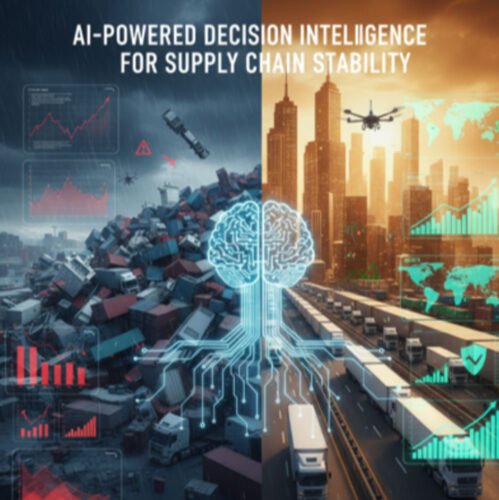
If the last few years have taught businesses anything, it’s this: supply chains don’t break politely. They snap without warning. A port shuts down, a shipment sits at the wrong airport, a supplier misses a commitment, or demand suddenly spikes out of nowhere. Most of these disruptions aren’t predictable, and the old way of reacting to emails, calls, dashboards, and long meetings just can’t keep up anymore.
This is exactly why so many companies are talking about Decision Intelligence. Not as a buzzword, but as a survival tool.
Why Decision Intelligence Is Becoming a Must-Have
Decision Intelligence, or DI, can sound a bit technical at first. But the idea is simple:
It’s a smarter way for companies to understand how decisions are made, improve them with data and AI, and automate the ones that don’t need human effort. Instead of depending on reports that arrive late, DI helps teams act in real time.
Think of DI as:
- A system that watches over the supply chain around the clock
- A platform that spots problems early
- A tool that suggests the best next steps
- And a process that becomes better every time it learns from new information
Gartner describes it as a practical discipline designed to improve decision-making by engineering how decisions are made and refined.” IDC adds that DI helps businesses automate or semi-automate the entire decision flow.
For supply chains, this means fewer surprises and a lot more control.
Why Supply Chains Struggle Without DI
Even strong companies face issues like:
- Last-minute supplier delays
- Inventory sitting in the wrong location
- Forecasts that don’t match reality
- Rising customer expectations
- Logistics bottlenecks
And the truth is, traditional analytics can tell you what happened, but they rarely tell you what to do next. Decision Intelligence fills that gap.
How AI Makes Supply Chains More Stable
When DI is powered by AI, companies start to see improvements in places where problems used to stay hidden. AI can pick up signals humans miss, simply because it can process more information faster.
AI helps supply chains by:
- Flagging risks early, like a sudden demand spike
- Suggesting ways to avoid stockouts
- Recommending supplier shifts
- Balancing inventory without manual effort
- Monitoring thousands of data points in real time
Instead of chasing problems, teams can finally stay ahead of them.
Aera Technology: A Practical DI Platform for Real-World Supply Chains
Among all the emerging DI solutions, Aera Technology is one of the platforms that practitioners mention often. And there’s a good reason: it’s built for real operations, not theoretical use cases.
Aera Technology offers a Decision Intelligence platform that brings together:
- Real-time visibility
- AI-driven insights
- Autonomous actions
- And continuous learning that sharpens decisions over time
Aera supports key functions such as supply chain, finance, and procurement, helping companies reduce manual work and act faster.
Where traditional tools only show data, Aera tells you the options and can execute some actions automatically, always with human oversight.
It feels less like software and more like having a digital teammate constantly monitoring operations.
How Aera Helps Create a Stable Supply Chain
Here’s what stands out about Aera’s approach:
1. Live Intelligence Instead of Static Reports
Aera doesn’t wait for scheduled updates. It reads data as it comes in, connects the dots, and informs teams immediately.
This helps businesses understand:
- What’s happening right now
- What’s likely to happen next
- Which decisions will prevent disruptions?
2. Autonomous Actions When Needed
One of Aera’s strongest capabilities is automation.
The platform can:
- Adjust purchase quantities
- Suggest supplier switches
- Move stock between locations
- Recommend the best alternative plans
This reduces manual decision fatigue and improves response time.
3. A System That Learns and Adapts
Every time Aera processes a decision, it stores what worked and what didn’t.
Over time, the system becomes more accurate, more practical, and more aligned with how a company operates.
It’s like training a digital analyst that never forgets.
Benefits Companies Are Seeing in Real Life
Organizations using DI platforms like Aera report improvements such as:
- More accurate demand planning
- Better supplier performance monitoring
- Reductions in inventory waste
- Faster reaction to market changes
- Higher customer satisfaction
- Lower operational costs
Most importantly, their supply chains become more predictable even when the market is not.
Why Smart Companies Are Moving Toward Decision Intelligence
The push toward DI isn’t coming from IT teams; it’s coming from business leaders who are tired of surprises. Decision Intelligence helps companies move from guessing to knowing, and from reacting to anticipating.
Companies adopt DI because:
- They want fewer emergencies
- They need consistent performance
- They want to cut manual decision-making work
- They need faster operations with less complexity
- AI is no longer optional for global supply chains
In a world where disruption has become routine, DI provides stability.
Final Thoughts
AI-powered Decision Intelligence is the next step in building resilient, agile supply chains. Instead of relying on outdated processes, companies can finally operate with confidence and speed.
Aera Technology is helping businesses take that step. Through its blend of AI, automation, and real-time intelligence, Aera makes supply chains steadier, smarter, and far more adaptable.
If your organization wants fewer disruptions, faster decisions, and smoother operations, Decision Intelligence isn’t just a new tool; it’s the foundation of a stable future.